



REVIEWS
Art reviews provide insight into the strength of Renée Radell’s contention for a place in the canons of significant American woman contemporary painters.
Reviews and critical acclaim have followed the career of Renée Radell for over 60 years. Her painting technique, Post-War and Contemporary paintings, and mixed media contemporary art have never failed to strike a favorable cord among art critics. Press coverage of art shows and painting critiques has ranged from local art commentators, to mainstream art critique by seasoned art industry gatekeepers and fine art influencers. In the academe, erudite essas and analysis from art history and intellectual history scholars delve deeply into the meaning of her social commentary statements.
Renée Radell’s drawings first appeared in the Detroit News about the looming World War II. Detroit Institute of Arts Director and co-founder of the Archives of American Art, Edgar P. Richardson, was an early enthusiastic supporter of young painter Renée Radell. Not only did he purchase one of her paintings for the permanent collection of DIA, but he wrote the catalog forward for her first one person oil painting art show in 1959.
1960s Critical Acclaim
At the time she appeared in mainstream New York City gallery exhibitions in the 1960s, the name Renée Radell was somewhat of a sensation.
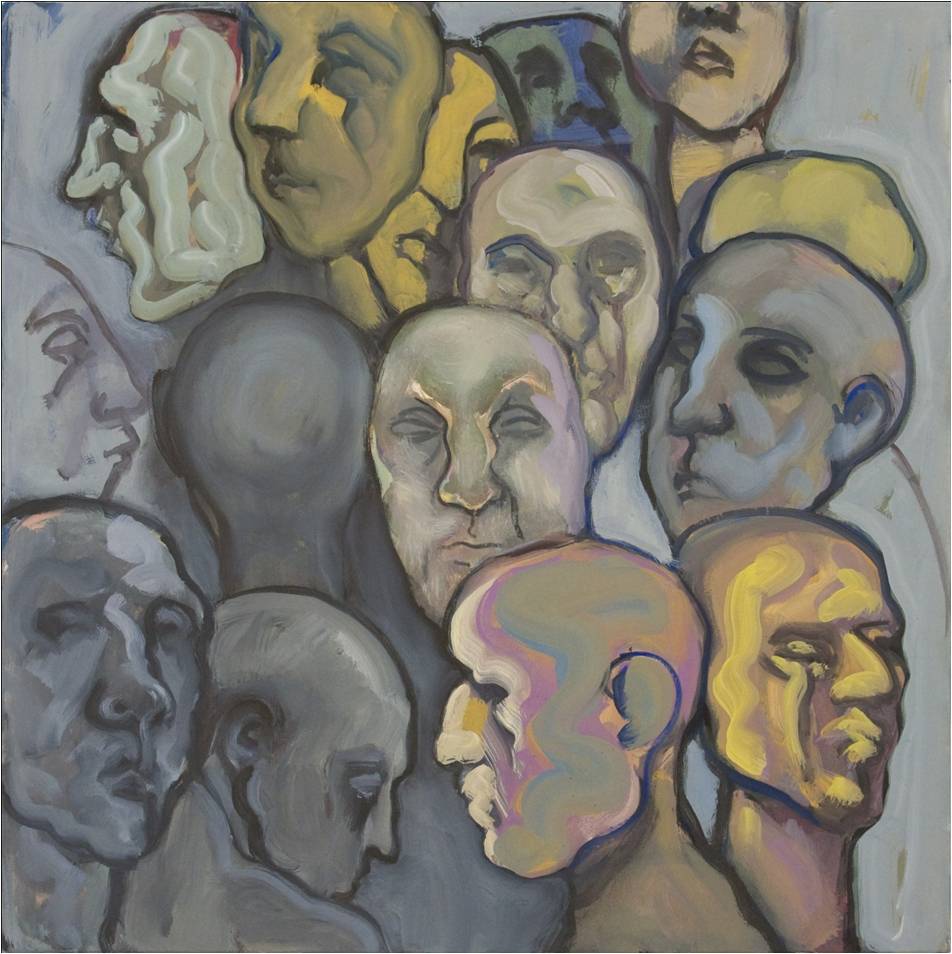
Not only had a petit female artist and mother of five from grassroots America broken through the glass ceiling in New York, but her figurative social commentary paintings conveyed a powerful perception of societal turmoil on a visceral level that few artists had attained. Remarkably, this ascendance was at a time that American Abstract Expressionism, Minimalism and Pop were the darling for the American Post-War art world.
Personal choices caused Renée Radell to resist the allure of New York and remain in Michigan until her ultimate move to Greenwich Village in the mid 1980s. By then, the art industry had been re-configured. Nevertheless, her increasing ventures into surrealism, symbol and allegory again attracted the attention of art journalists and critics.
Web of Circumstance
Renée Radell Web of Circumstance by Eleanor Heartney provides keen insight into challenges that women artists face on the path to recognition. Nevertheless, the level and consistency of critical acclaim for the art of Renée Radell is impressive by any standards for living artists. Please consult the Bibliography section herein for more information and source material.
– Editor
“Renée Radell exemplifies the triumph of art over circumstance. She is proof of Nochlin’s slyly unstated point: There are indeed great women artists. Radell’s unique synthesis of art history, philosophy, social observation and formal experimentation has yielded a body of work that will stand the test of time. Her lifelong dedication to the most profound questions of existence will continue to resonate for all who care about the human condition.”
–
Eleanor Heartney, Renée Radell Web of Circumstance (Predmore Press) 2016
“Her art today is not a charming and “artistic” one; it is one of passion and power, which one looks at carefully and with the most serious attention.”
–
Edgar Pr. Richardson, Director Detroit Institute of Arts 1959
Empty section. Edit page to add content here.
“[Her career] amounts to a signal achievement in American art. Radell stands with the best artists of her generation not only as a gifted figurative painter but also as one whose works plumb the philosophical, political, and spiritual dimensions of our age.”
–
Gregory Wolfe, University Bookman 2017
“How exciting is the chance to see a survey of works by a classic figurative painter like Renée Radell! Her pictures are powerful expressions, whether theological, political or pastoral…rich allegories of life and death from an artist who is a master of her craft.”
–
Walter Robinson, artnet Magazine, November 2007
“The common denominator over 25 years is the stunning virtuosity with which she draws and paints.”
–
Rita Fuchsberg, Artspeak, March 1, 1985
“If ever the poems of T.S. Eliot should be published in a splendid illustrated edition, Renée Radell ought to be the illustrator. For like Eliot, Mrs. Radell shows us the symbols of hell, purgatory, and paradise in 20th century forms.
Her armed vision discerns the boredom, and the horror, and the glory of this age. Her high talent with the brush transmutes a moment’s experience to a timeless image. She is a painter possessing moral imagination.”
–
Russell Kirk, The Sunday News Magazine, The Detroit News, February 24, 1974.
“Recent works by this Voltaire of the brush give the feel of vast murals no matter what their size. Amazingly there is no repetition in these powerful yet whimsical attacks on human foibles. Meanwhile the technical side is consistently of the highest quality of firm, disciplined brushwork, with a gradual increase in the use of collage…Each work tells something biting while the overall beauty of it leaves you with a sense of human triumph.”
–
W.D.A. artsmagazine, March 1969
“design, -subtle, supple, caustic – and brushstrokes, – sober, velvety, poignant – join together in perfect balance… her art is cinemagraphic – like a contemporary fresco in motion.”
–
Saint-Evremond, Le Courier des Arts, October 5, 1970
“Mrs. Radell’s ability to escape the closeted world so often forced on women by domestic duties is a heroic effort. Flying well beyond children and flowers, her mind ranges across the terrain of society like a parting, hawk-like conscience. And it settles on outcroppings of decadence. Her people are witless and vapid shells that cannot pull themselves into existence…Her brush flies flat with paint or skims in thin, dripping washes – and it creates colors and shapes that call forth a series of dairy fantasies…At times her lush painterly banquet asserts itself over the decadence it portrays. That is how we understand that Mrs. Radell is a painter rather than a reformer.”
–
William Tall, Detroit Free Press, October 20, 1969
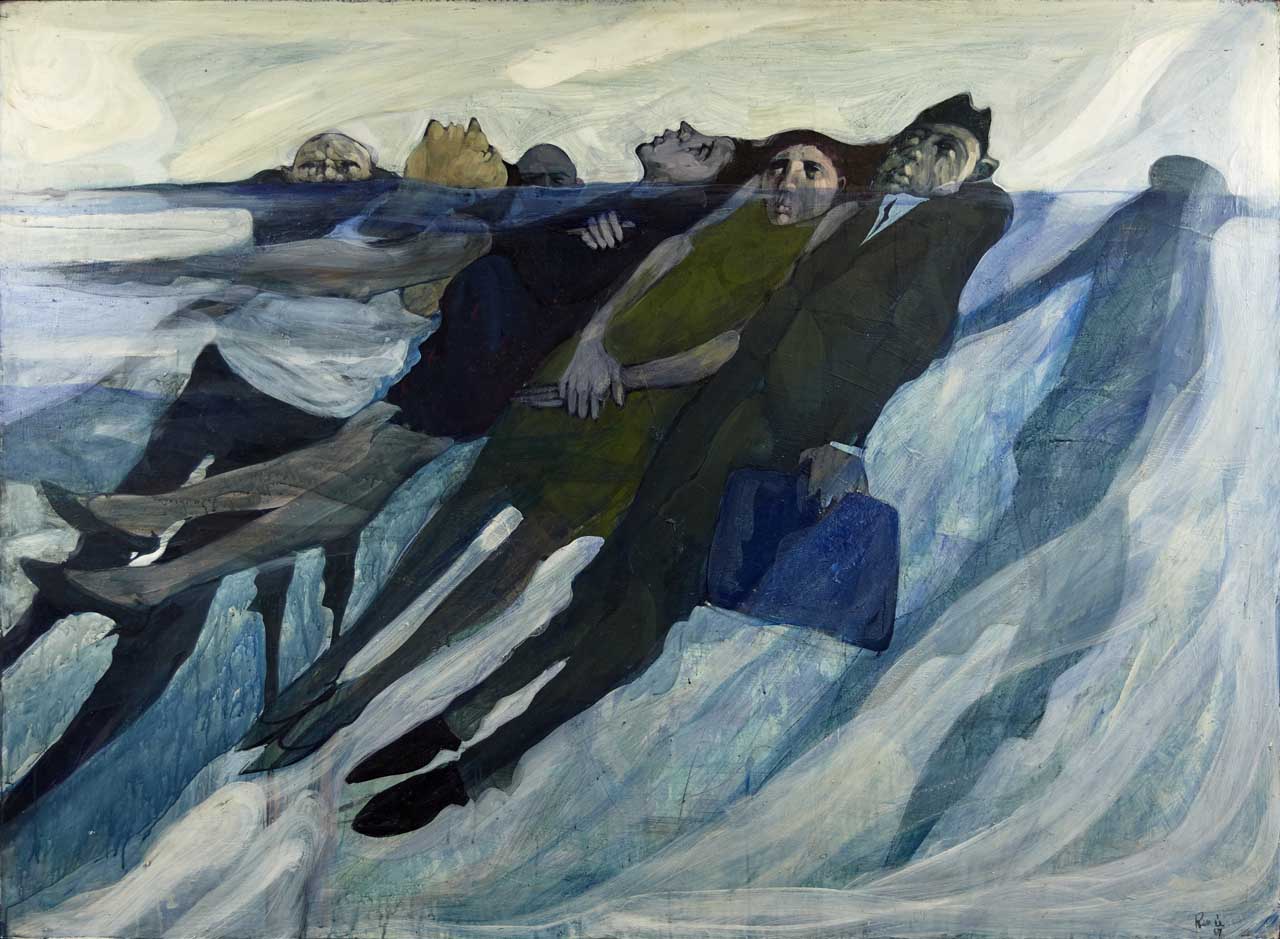
“In her work, pathos and poetry grow in exalting each other.”
–
Fernand Tramier, La Revue Moderne, May 1, 1966
“Radell is a powerful artist who is as strong a social commentator as she is a painter.”
–
H.G.L., Park East, New York October 5, 1967
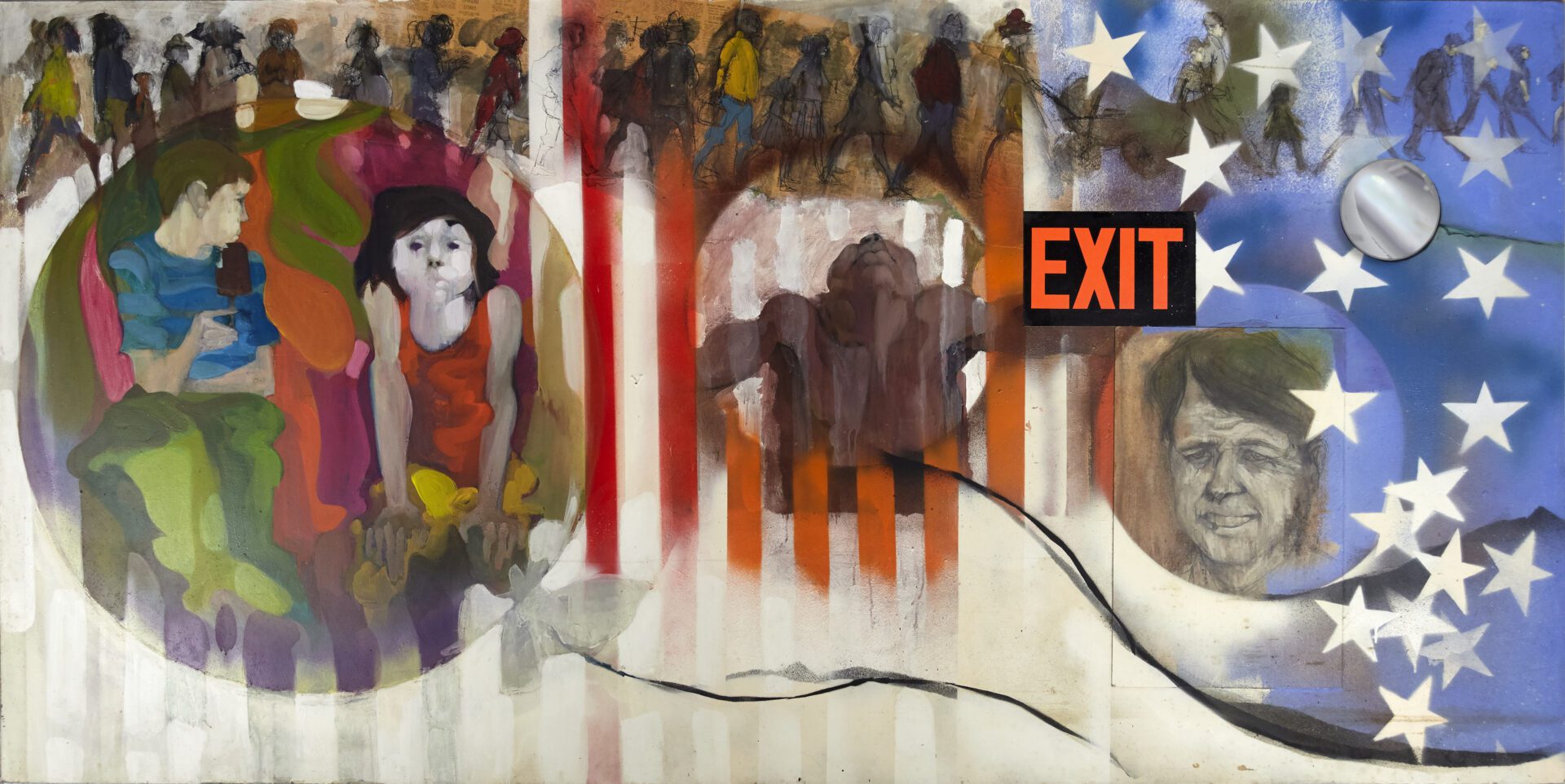
“A huge work, ‘With Liberty and Justice for All’, epitomizes all the poignancy and grief resulting from the tragedy of Robert Kennedy’s untimely death. Here are the disadvantaged, the young – all those to whom he provided inspiration – as they continue in their search for a better world. This painting includes an exit sign, the stars and stripes and even a bit of space; it is an almost overwhelming opus.”
–
H.G.Landon, Park East, the Magazine of New York, March 6, 1969.
“(Radell) creates a moving set of images in exquisite color and with expressive details of drawing… they re-establish the artist in one’s mind as a craftsman of consummate skill and sensitivity.”
–
Ken Saltmarche, Windsor Star, April 27, 1968
“Winner of many prizes and critical acclaim, Renée Radell has grown steadily until now we have the feeling of being in the presence of a major artist of our time. In looking at her work one is struck by the inner awareness of the figure portrayed to an emotional, poetic situation. It may be a child, a priest, a woman or a group at a discotheque: in each the social comment is brought out by the subtle use of color and by a balance of form that creates within the viewer the sensation of loneliness of man in the crowd of humanity. There is humor, pathos, gaiety and a calm sadness perfectly in keeping with a style that is uniquely her own. These are not pretty paintings – but a moving, emotional works that have a deep fascination and haunting beauty that prove fresh with each new viewing.”
–
Robert Shuster, New York 1967
Renée Radell is not a Surrealist, but in her souped-up realism is the ritual unemployment of a dream. She sustains a stern psychological undertow. Her people are drowning, unprepared, pregnant, grabbing for power flowers, privileged, then let go.”
–
Marlene Zucker, Art News, November 1967
“The cynicism which she sometimes exposes cannot hide the emotional richness such as in a suggestion of a water colorist, which is shown in the subjectivity of her melting colors and the subtle ease of her drawing.”
–
Saint-Evremond, Le Courier des Arts, October 5, 1967.
“These are powerful paintings in the Expressionist tradition of Joseph Levine and Ben Shahn. However, Radell expresses a humanism and a pathos that is more universal and more moving than the older forms of social commentary.”
–
Cindy Nemser, artsmagazine, November 1967
“…explosive canvases…almost an ethereal beauty…”
–
Patricia Burnstein, New York Sunday News, October 8, 1967
“Renée Radell is an accomplished, relatively young painter of penetrating and vigorous insights.”
–
J. M. McC., New York Pictures on Exhibit, May 1965
“Here is a colorist painter who is not afraid to seek her effects in monochromatic painting, and who knows how to attain the height of emotion and sustain it by means of a stylization whose restraint is all the more aesthetic…bordering on expressionistic lyricism…”
–
R. Clermont, La Revue Moderne, January, 1961
“Six years ago, Renée Radell’s first solo show disclosed a painter with great potential. Her second opening this Sunday at Garlick’s Gallery, more than fulfills every promise made then. Expressiveness has matured into passion. Sublety has grown into power. And her once objective interests have turned inward with intensity.”
–
Joy Hakanson, The Detroit News, January 11, 1959
“Mrs. Radell’s talent for recording subtle impressions has been established during past seasons. But now added warmth and richness have put her figure paintings in a class by themselves.”
–